
How to Use Voiceover Mode
You recorded the narration yourself. In voiceover mode Cliptude transcribes your audio, plans scenes to match what you say, sources the footage and graphics, and renders the video with your voice as the soundtrack. No AI voice is used or charged.
At a glance
- You bring: one audio file of the full narration.
- Cliptude does: transcription, scene planning, footage, graphics, captions and the render.
- Formats: MP3, M4A, WAV, WEBM, OGG, FLAC. Up to 200 MB.
- Length: 6 to 60 minutes. Under 6 minutes is refused, and the length comes from the file.
- Price: an uploaded voiceover is billed at the lowest voice rate. Ask for
estimate_creditswith the audio length in seconds.
1. Connect your agent and install the skills
Any agent that speaks MCP works: Claude, ChatGPT, Claude Code, Codex, Cursor and others. Connect it to the Cliptude MCP server and sign in, or use the CLI if your agent has no MCP. In Claude and ChatGPT, Cliptude's tools open pickers and cards inside the chat. Agents that show no widgets, such as Claude Code, Codex and Cursor, give you a cliptude.com/pick link with the same picker instead.
https://mcp.cliptude.com/mcp

npm i -g @cliptude/cli
cliptude auth login

npx skills add cliptude/cliptude
Connection steps for each agent are in the API docs. The skills tell the agent the workflow, so you don't have to explain it.
2. Get the audio to Cliptude
Two ways, depending on where your agent runs.
- Local agent or the CLI: give the file path (
voiceover_path, or--voiceover narration.mp3). - Remote agent such as claude.ai: it can't read your disk, so give it a public link to the file (
voiceover_url).
3. Brief your agent
Copy this prompt and fill in the brackets.
Connect the Cliptude MCP server at https://mcp.cliptude.com/mcp and sign in. If you can't use MCP, install the CLI with `npm i -g @cliptude/cli` and run `cliptude auth login`. Then install the Cliptude skills: `npx skills add cliptude/cliptude`.

Make a video from my voiceover [path or public URL] using my [template name] template.

Pass it as voiceover_path (or voiceover_url). Do not write a script and do not pass a prompt or script: Cliptude transcribes my audio and skips the AI voice. Do not set a duration.

Call estimate_credits with the audio length as voiceover_seconds and show me the cost and my balance before you create the job. Then create the job and poll get_job until it is completed or failed.
In Claude or ChatGPT: pick the template, then confirm
Connect the Cliptude MCP server (https://mcp.cliptude.com/mcp) and ask your agent for a video. It starts
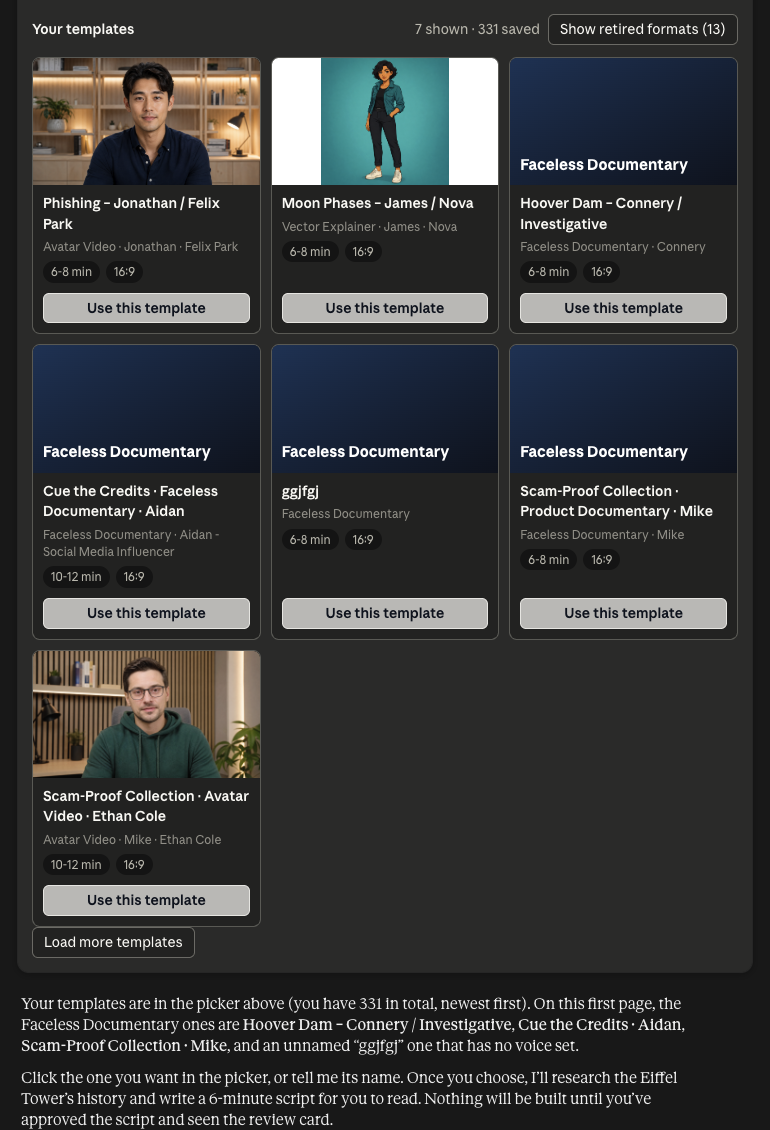
with your saved templates: in Claude and ChatGPT, list_templates shows them as a gallery. Avatar Video
cards show the presenter and Vector Explainer cards the character. Load more templates
shows the rest, and templates in retired formats stay hidden behind a button. Click
Use this template on the one you want.
If none fits, the agent builds a new one with the pickers, one at a time: voice, then the presenter (Avatar Video)
or character (Vector Explainer), then music, background and style. create_template and
get_template show the result as a template card with every setting, plus
Make a video with this template and Change something.
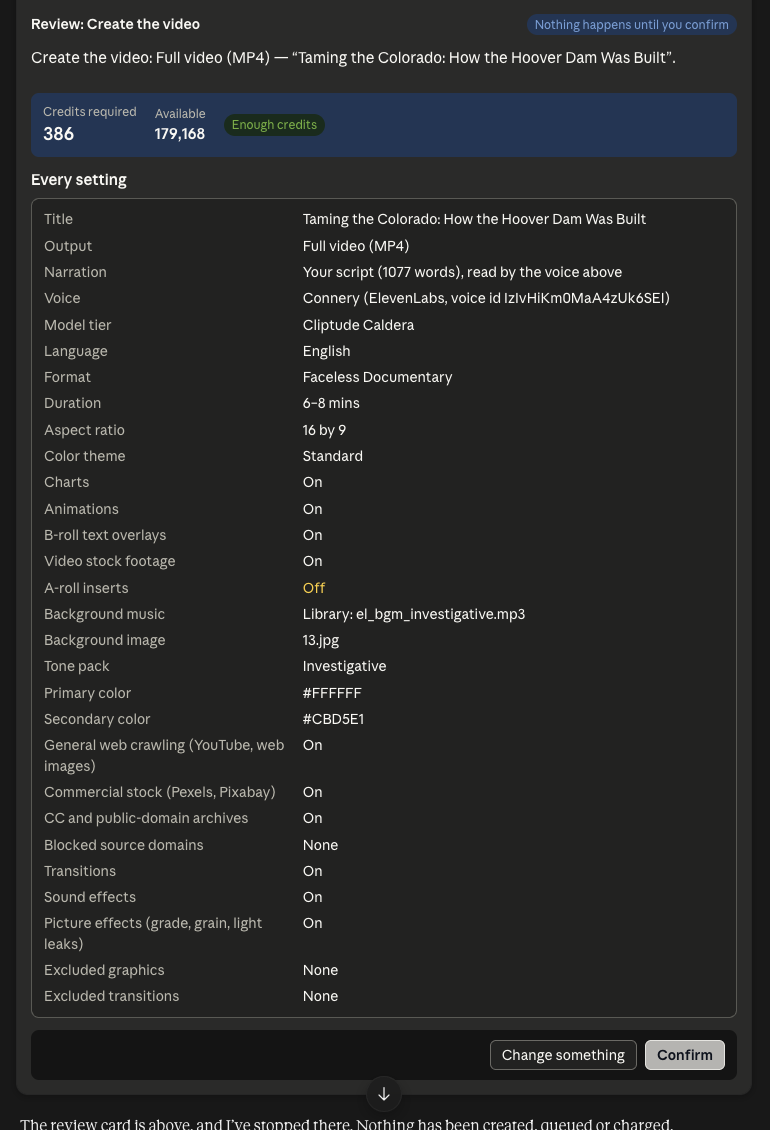
Before anything is created or charged, the agent shows the review card: every setting, any warnings, a checkbox for anything you turned off, and the credits. The Script (N words) tab holds the script. Nothing happens until you click Confirm.
In Claude a click saves your pick on Cliptude and the picker says "Saved. Type next in the chat to continue."
Type next and the agent carries on with it. In ChatGPT the pick is sent as your next message.
Claude Code, Codex, Cursor and other agents that show no widgets give you a cliptude.com/pick link with the same
picker instead. It works once, for 15 minutes, and only
for you when you are signed in. The agent reads the result with get_pick. From a terminal:
cliptude pick <pick_id> --url <link> opens it and waits.
Setup for each agent: Claude, ChatGPT, Claude Code, or any other MCP agent.
4. What happens next
- Review card.
create_jobfirst returns a review and creates nothing: every setting, any warnings and the credits. In Claude and ChatGPT it shows as a card with a Script tab and a Confirm button. Nothing is queued or charged until you confirm. - Transcribe. Cliptude transcribes your recording and finds the sentence and word timings.
- Plan. Scenes, footage and graphics are matched to what you say.
- Build and render. Your audio is used as is. A job takes about 10 to 40 minutes.
5. Tips for the best result
- Record in a quiet room. Cleaner audio gives a more accurate transcript.
- Use MP3 or WAV at 44.1 or 48 kHz.
- Stay on topic. Unrelated sections at the start or end confuse scene planning.
- You can't combine a voiceover with a prompt, a script or a talking-head video in one job.
- Want to supply your own footage too? See Render Mode.
- The upload form is also on the website: Voiceover Upload.