
Psychology of learning and the mind
How to start a faceless psychology YouTube channel
Everyday psychology explained one idea at a time: why we forget, how memory works, why we act the way we do.
How Cliptude makes it: Faceless narration + warm cinematic footage, one huge word on the picture, names in giant type
The reference channel: Psychology Decoded
@PsychologyIsDecoded-1 · joined 2026-04-12 · checked 14 November 2026
Why this niche works
- Psychology Decoded is monetized at an estimated RPM of $4.11, so 263,731 estimated monthly views come to about $1,084 a month, and Social Blade's last two weeks (+99,329 views) are on the same pace.
- Its breakout is a learning topic, not dark psychology: "Memorize Anything So Fast It's Almost Unfair" has 489K views and its follow-up about prisoners learning faster has 139K.
- Longer videos win here: its two biggest hits run 22 and 21 minutes, against 10:35 on average, so practical how-your-mind-works deep dives earn more mid-rolls.
- The channel is 217 days old with 45 videos (about 1.5 a week, counted from its video total), so a modest posting pace is enough when the topic hits.
Top videos on Psychology Decoded



What a copy could earn
Videos a month × views per video × $4.11 RPM. Illustrations, not promises.
| Slow start | 8 × 4,000 | $132/mo |
| On pace | 12 × 30,000 | $1,480/mo |
| Breakout | 12 × 150,000 | $7,398/mo |
Competition
HighPsychology is a big faceless niche with channels in the hundreds of thousands of subscribers, most of them doing "people who do X have these traits" lists. Evidence-based learning and memory videos are a smaller lane where a young channel can still break out.
| Channel | Subs | Avg views |
|---|---|---|
| Psychology Simplified 360 days, est. ~$1,838/mo; "Psychology of Gen X" 3.5M |
274,000 | 144,372 |
| Psychology Explained 256 days, illustrated stills, est. ~$444/mo; one 799K hit |
13,300 | 33,890 |
| Psychology Simply Decoded 273 days, est. RPM $5.10, est. ~$349/mo |
15,600 | 11,430 |
How the Bold Lessons Look matches
Psychology Decoded uses a cream paper look with simple hand-drawn heads and a calm voice, about 10-20 minutes per video. Bold Lessons gives the same one-idea-at-a-time feel as a warm footage essay: footage of the idea on almost every line (a desk, a notebook, a student at night), one charged word laid huge across the picture with Big word over, and each researcher's name in giant type the first time they are named. It puts no cards, charts or drawn heads on screen, so the study numbers live in the narration; for a drawn version closer to the reference, use the Vector Explainer format with the Flat vector art style.
Make it in Cliptude
- 1Pick the Bold Lessons Look, format Faceless documentary, 10-20 minutes.
- 2Script shape: one question, the study that answers it (who, when, what they found), why it works, how to use it, a one-line takeaway.
- 3In the prompt mark the one word per section you want on Big word over, and give each study's authors and year.
- 4Describe the footage under each idea (a desk at night, a closed book, a calendar) and ask for no stock filler.
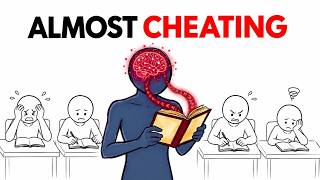
- 5Thumbnail reference: Psychology Decoded's plain background with a simple head drawing and a short claim ("Almost Unfair").
- 6Post 1-2 a week and build a series (Psychology of Intelligence 1, 2, 3) the way the reference does.
Psychology video title ideas
The formula Psychology Decoded wins with: Psychology of Intelligence: [promise], or Why [habit] [surprising effect]
- Psychology of Intelligence: The Forgetting Curve and How to Beat It
- Why Testing Yourself Beats Rereading Your Notes
- Spaced Repetition: Why Cramming Fails
- The Feynman Technique: Learn Anything by Teaching It
- The Zeigarnik Effect: Why Unfinished Tasks Stick in Your Head
- Why Multitasking Makes You Learn Less
Fresh titles in the same pattern. Check each story's facts before you script it.
Why Rereading Your Notes Doesn't Work (And What Does)
Most people study by rereading; two classic findings show a better way, which makes a practical, surprising learning video.
The comfortable mistake
When most people want to remember something, they read it again. And again. It feels like learning. The words look more and more familiar each time. But familiar is not the same as remembered. Psychologists have tested this for well over a century, and the results are clear: rereading is one of the weakest ways to learn. There are two simple changes that work far better, and neither one needs extra study time. Today we will look at the research behind them, and how to use them tonight.
On screen: Warm footage of someone rereading a notebook at night; Big word over 'FAMILIAR'.
The forgetting curve
The story starts in the 1880s with a German psychologist, Hermann Ebbinghaus. He taught himself long lists of nonsense syllables, like "DAX" and "BOK", so that meaning could not help him. Then he tested how much he still remembered after different amounts of time. He found that memory drops fast at first, most steeply in the first hour, and then levels off after about a day. He drew this as a curve, now called the forgetting curve. He also found that relearning a list was faster than learning it the first time, and that spreading his practice out worked better than cramming it into one sitting.
On screen: Big word over name 'Hermann Ebbinghaus' with 'psychologist, 1885'; footage of old handwritten lists; Big word over 'FORGET'.
Change one: space it out
That last finding is the key to the first change: spacing. If you study the same material in several short sessions spread over days, you remember it far longer than if you study it in one long session. This is called the spacing effect, and it is one of the most repeated results in all of psychology, confirmed in hundreds of experiments. One 2006 review pulled together 317 of them. Cramming the night before a test can work for the next morning. But it fades much faster. Spacing makes memory last.
On screen: Footage of short study sessions on different days; Big word over 'SPACE'.
Change two: test yourself
The second change is testing yourself. In 2006, Henry Roediger and Jeffrey Karpicke at Washington University in St. Louis asked students to learn short prose passages. Some students read the passage four times. Others read it once and then tried to write down everything they could remember, three times. Five minutes later, the rereaders did slightly better, 81 percent to 75. But one week later, the result flipped. The students who had tested themselves remembered about 61 percent, and the students who had only reread remembered about 40 percent. The rereaders also predicted they would do better than the testers. They felt more confident, and they were wrong.
On screen: Big word over names 'Henry Roediger' and 'Jeffrey Karpicke' with '2006'; footage of students writing from memory; Big word over 'TEST'.
Why it works
Why does testing beat rereading? When you reread, the answer is right in front of you, so your brain does very little work. When you try to recall something from memory, you have to search for it and rebuild it, and that effort strengthens the memory. It feels harder, and that is the point. Psychologists call these desirable difficulties: struggles that slow you down now but help you later. The irony is that the method that feels less productive is the one that actually works. This is why many teachers now give low-stakes quizzes. The quiz is not just a way to measure learning. It is a way to create it.
On screen: Footage of a student pausing to recall, eyes closed; Big word over 'STRUGGLE'.
How to use it tonight
Here is how to use both ideas. After you read something, close the book and write or say everything you remember, then check what you missed. Turn your notes into questions instead of summaries, and answer them without looking. Then spread your practice out: test yourself today, again in two or three days, and again in a week. Flashcards work well for this, as long as you try to answer before you flip them. It takes the same time as rereading. It just asks more of your brain.
On screen: Footage of a closed book and a hand writing questions on cards; Big word over 'RECALL'.
The takeaway
So the next time you sit down to study, notice that comfortable feeling of familiarity, and do not trust it. Rereading tells you that you have seen something. Testing tells you whether you know it. Ebbinghaus showed that memories fade fast unless we return to them. Roediger and Karpicke showed that the best way to return is to pull the memory out, not to look at it again. Recall, then space it out. That is the whole method, and it works for anyone. Try it with the next thing you need to learn, and test yourself in a week.
On screen: Warm footage of a desk at dawn; Big word over 'RECALL', then 'SPACE' in red.
Psychology channel questions
How many views does a psychology channel need to make $2,000 a month?
At the $4.11 RPM estimated for Psychology Decoded, about 486,618 long-form views a month make $2,000 from AdSense. That is roughly 28 videos at this channel's average of 17,289 views each.
How much does a psychology YouTube channel make?
Psychology Decoded is 217 days old with 5,330 subscribers and earns an estimated $1,084 a month from 263,731 monthly views. Sponsorships and affiliate income come on top of that.
Is psychology a good YouTube niche in 2026?
Competition is high. Psychology is a big faceless niche with channels in the hundreds of thousands of subscribers, most of them doing "people who do X have these traits" lists. Evidence-based learning and memory videos are a smaller lane where a young channel can still break out. Channels to study: Psychology Simplified, Psychology Explained, Psychology Simply Decoded.
Can you make psychology videos without showing your face?
Yes. In Cliptude, the Bold Lessons Look makes these videos from a script, with no presenter on camera: faceless narration, warm cinematic footage, one huge word on the picture, names in giant type.
Make your first video in this niche
Open the Bold Lessons Look, paste the script above or your own topic, and Cliptude builds the narration, footage and on-screen boards.
Sources
- https://www.youtube.com/channel/UChMrMzP1iRBBnA5c-SQJDpA/videos
- https://socialblade.com/youtube/channel/UChMrMzP1iRBBnA5c-SQJDpA
- https://journals.sagepub.com/doi/10.1111/j.1467-9280.2006.01693.x
- https://psychclassics.yorku.ca/Ebbinghaus/index.htm
- https://pubmed.ncbi.nlm.nih.gov/16719566/
- https://source.washu.edu/2006/03/repeated-testtaking-better-for-retention-than-repeated-studying-research-shows/
- https://en.wikipedia.org/wiki/Hermann_Ebbinghaus
- https://www.sciencedaily.com/releases/2013/01/130110111734.htm
- https://en.wikipedia.org/wiki/Desirable_difficulty
Figures are estimates checked 14 November 2026, cross-checked on Social Blade and YouTube. Revenue is AdSense only and real RPM varies. Channel names and video titles belong to their owners; Cliptude is not connected to any channel listed. All 26 niches